


















VISIBILITY ISN’T THE PROBLEM. AWARENESS IS.
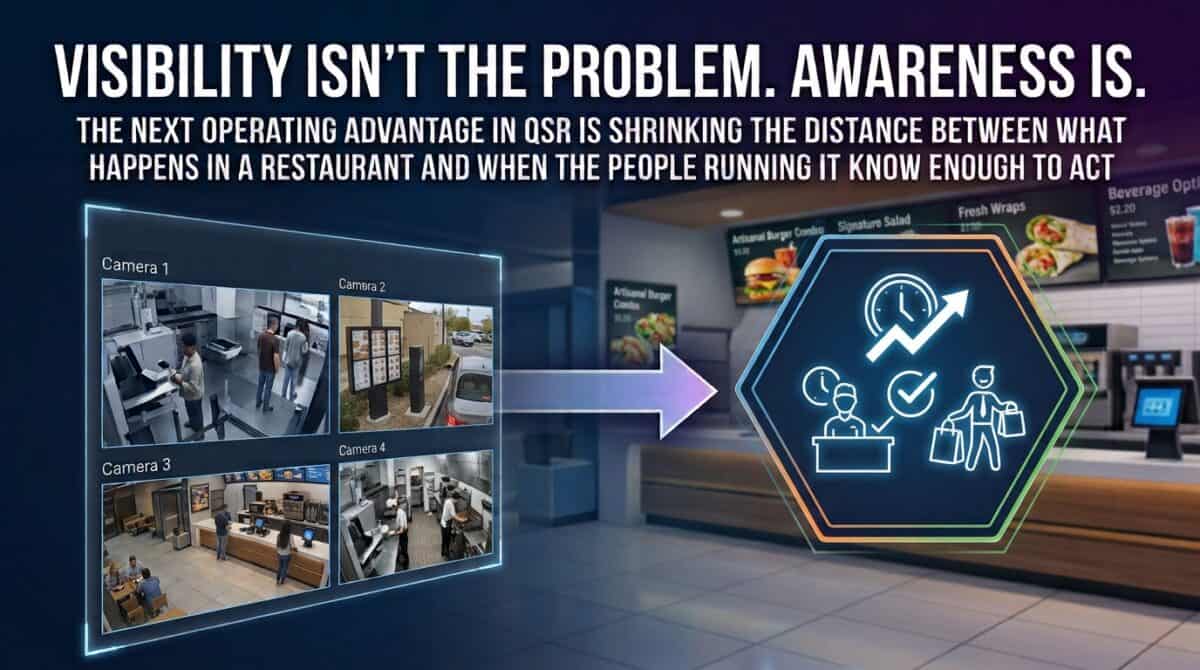
The next operating advantage in QSR will come from shrinking the distance between what happens in a restaurant and when the people running it know enough to act.
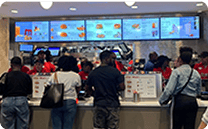
QSR operators do not have a visibility problem. Most have more information than any generation of restaurant leaders before them: cameras, POS data, labor systems, drive-thru timers, guest feedback, audits, dashboards and reports. Yet one of the most consequential moments in a restaurant can still happen almost invisibly: a queue builds, a service position goes uncovered, a drive-thru slows, or a guest gives up and leaves.
The information often exists. The problem is that the people who can change the outcome receive it after the outcome is no longer changeable.
That is the distinction I believe our industry needs to focus on now: the gap between visibility and operational awareness. Information can be abundant while awareness is still scarce.
THE HIDDEN COST OF OPERATIONAL LATENCY
I think of this gap as operational latency: the time between a condition emerging, someone recognizing that it matters, and the restaurant responding. In a QSR, that gap may be measured in minutes, but the consequences compound quickly. A line gets longer. Throughput slows. A team gets more stressed. A guest leaves. By the time the issue appears in an end-of-day report, the data may be perfectly accurate and operationally useless for that moment.
Historical reporting and analytics remain essential. They answer important questions: How did we perform? Where are we off standard? Which restaurants or dayparts need attention? But restaurants have a second, fundamentally different question: What is happening right now that deserves attention while there is still time to improve the outcome?
A general manager or shift leader cannot watch every camera, dashboard and system while also running a restaurant. Nor should we expect them to. Their job is to serve guests, lead people, solve problems and make judgment calls in a changing environment. Technology should compete for their attention only when it has earned the right to do so.
AI SHOULD STRENGTHEN JUDGMENT, NOT REPLACE IT
This is where AI can make a practical difference. Not AI as a promise to run the restaurant, and not AI as another dashboard. Its most useful role is to make attention more intelligent.
AI can continuously monitor operating conditions that a person cannot reasonably observe at scale. It can detect that a guest queue has crossed a threshold, that demand is surging, that an important service area appears uncovered, that speed of service is deteriorating, or that a defined operating or policy exception may require review. It can measure patterns consistently and bring the right event to the surface sooner.
But awareness is not the same as judgment. The manager on the ground knows the context: who is on the shift, what equipment is down, what just happened in the kitchen, whether a bus arrived, and which tradeoff makes sense at that moment. The closer technology gets to the moment of action, the more important it is to respect that local expertise.
The operating model I believe in is therefore simple: technology detects, measures and alerts; people interpret, decide and act. The goal is not to remove the human decision. It is to give the person best positioned to make that decision better information, earlier.
ONE SIGNAL, TWO LEVELS OF VALUE
The same operational signal can create value at two very different altitudes.
At the restaurant level, the value is immediacy. A general manager or shift leader can see that a condition needs attention while the shift is still underway and respond according to the brand’s standards and the reality on the ground.
Above the restaurant, the value is learning. Operations, loss prevention, brand standards and other corporate teams can see whether the same conditions recur by location, daypart or region. What is a real-time event for one manager becomes an objective pattern for an area leader or corporate function. That is how in-the-moment awareness can become better coaching, better staffing decisions, stronger process design and more consistent execution over time.
Real-time local awareness and enterprise-level insight should not be separate ideas. They are two uses of the same operational truth.
FROM A REAR-VIEW MIRROR TO AN OPERATIONAL SENSOR
Video illustrates the shift particularly well. For years, the industry has primarily treated video as evidence: something to review after an incident, investigate after a loss, or verify after a question arises. Those uses remain important. But AI now gives us the ability to turn existing video and other restaurant data into operational signals while the business is happening.
Inside the restaurant, that can mean greater awareness of guest flow, queues, service-area coverage, speed of service, cleanliness and customer-defined exceptions. In the drive-thru, it can mean understanding the customer journey much earlier than the traditional lane timer can, from pre-lane arrival through ordering, service and the wait bay – so teams and above-store leaders can see where time is being gained or lost.
This does not mean creating more alerts. If every condition becomes an alert, awareness simply turns back into noise. Useful operational intelligence requires customer-defined conditions, sensible thresholds and a clear understanding of which events are important enough to interrupt a busy restaurant team.
THE STANDARD WE SHOULD SET FOR THE NEXT GENERATION
As the restaurant industry adopts AI, I believe we should judge new technology against a more demanding standard than whether it can generate another insight. It should do four things: reduce the time from signal to awareness; preserve and strengthen local judgment; connect restaurant-level action with above-store learning; and ultimately improve the operating outcomes that guests and restaurant teams actually experience.
That matters because the competitive advantage is not having the most data. It is having the shortest, clearest path from a meaningful signal to an informed response, and then using what was learned to make the next shift better.
A PREVIEW IN ATLANTA
At QSR Evolution in Atlanta, DTiQ will preview some of the ways we are applying this principle in practice. We will show new AI-powered operational intelligence capabilities designed to surface in-store service conditions and defined execution exceptions while a shift is underway, measure in-store speed of service, and extend operational awareness across the complete drive-thru journey. We will formally introduce the new offering later in September.
The point is not technology for its own sake. It is to give the people running the restaurant a better chance to change an outcome while it can still be changed, while giving above-store leaders a clearer, more objective view of where the operating system itself can improve.
The QSR brands that lead the next phase of this industry will not necessarily be the ones that collect the most information. I believe they will be the ones that get better at converting signals into timely awareness, awareness into sound local decisions, and those decisions into repeatable operational learning.
In a business where minutes matter, knowing sooner only has value if it helps someone act better. That is the evolution worth pursuing.
If you are attending QSR Evolution, I look forward to comparing notes on where the industry is heading and what better operational awareness should look like in practice.
— JL Valente, CEO, DTiQ